How to Identify Unknown Charges on Your Bank Statement
What Makes a Bank Charge Hard to Identify?
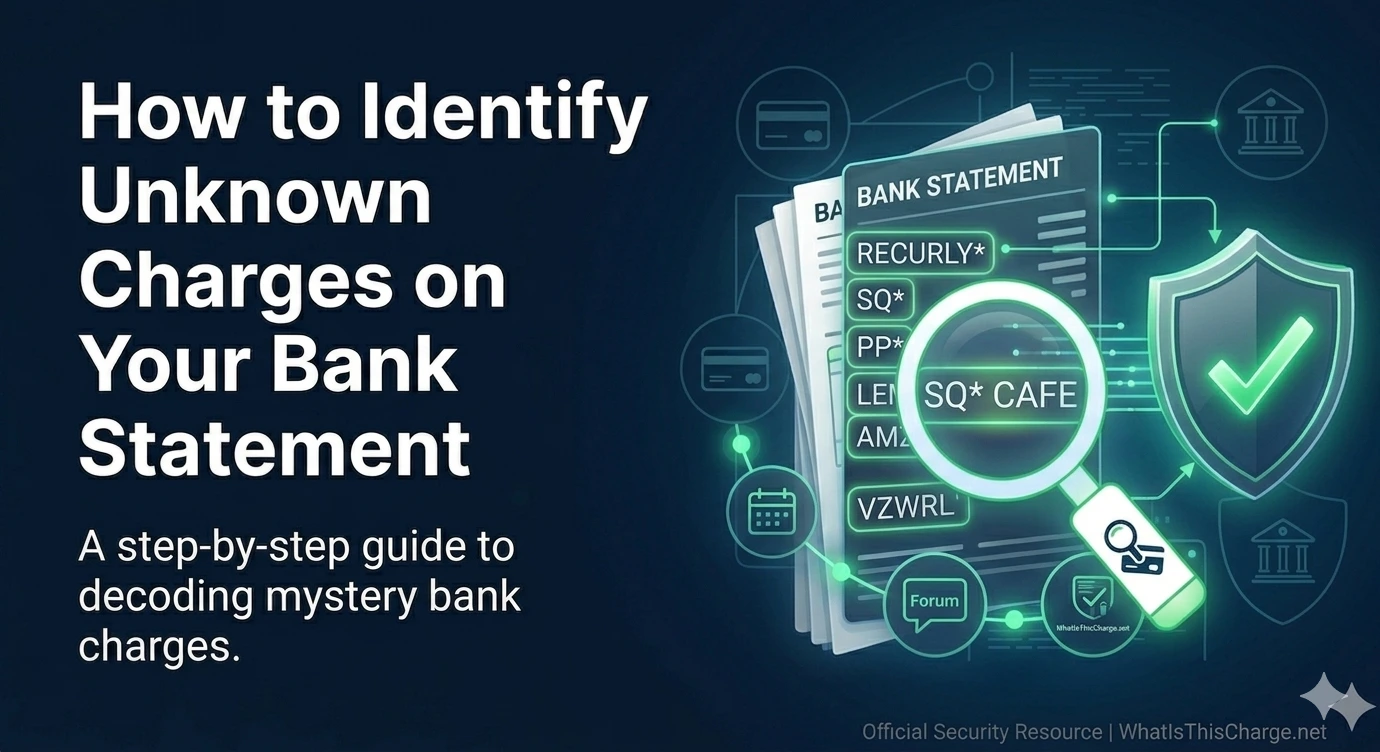
Bank statements show payment descriptors — short codes assigned by merchants when they register with their payment processor. These descriptors are often abbreviated, use legal business names instead of brand names, or reflect the payment processor rather than the merchant.
Payment descriptors are limited to 22 characters by most card networks, which is why they are often truncated in ways that make them hard to recognize.
ℹ️ Note
Even charges you authorized can look completely unfamiliar on your statement. A charge from a popular app might show the parent company name instead of the product you know.
Is the 'This Charge' Charge on Your Bank Statement Legitimate or Fraud?
If you've spotted 'this charge' on your bank or credit card statement, you're not alone — many people search for this exact descriptor wondering what it means. The label 'this charge' can appear generically when a merchant's billing system does not transmit a clear business name to your bank, resulting in a placeholder-style description. Before assuming fraud, it's worth investigating whether a recent purchase or subscription is responsible.
- Generic descriptors like 'this charge' often appear when a third-party payment processor is used instead of the merchant directly
- Subscription services that bill through aggregators may show up as 'this charge' on your statement
- Free trials that convert to paid plans sometimes post under vague names like 'this charge'
- Fraudulent actors occasionally use nondescript labels to avoid detection, so verification is always important
How to Verify the 'This Charge' Charge on Your Statement
- 1
Note the exact amount and date
Write down the precise dollar amount and transaction date of 'this charge' — this information is essential for matching it to a real purchase or subscription in your records.
- 2
Search your email for receipts
Search your inbox for receipts or order confirmations sent around the same date as 'this charge' — look for keywords like 'order,' 'receipt,' or 'invoice' to narrow results.
- 3
Check your active subscriptions
Log into services you subscribe to and review their billing history — 'this charge' may correspond to a renewal from a streaming, software, or membership platform.
- 4
Ask household members
Check with family members or others who share your account — someone else may have made a purchase that posted as 'this charge' without your immediate knowledge.
- 5
Contact your bank for merchant details
Call the number on the back of your card and ask your bank to look up the full merchant information behind 'this charge' — banks can often retrieve the original business name.
How to Dispute a 'This Charge' Charge on Your Bank Statement
- 1
Act within 60 days
Most banks require disputes to be filed within 60 days of the statement date on which 'this charge' appeared — acting quickly protects your right to a chargeback.
- 2
Attempt to identify the merchant first
Before filing a dispute, exhaust all identification steps — disputing 'this charge' prematurely when it turns out to be a legitimate purchase can complicate your account standing.
- 3
File a dispute with your bank or card issuer
Contact your bank's dispute department by phone or through your online portal, referencing the exact date and amount of 'this charge' and stating you do not recognize it.
- 4
Request a new card number
If your bank confirms 'this charge' is unauthorized, request a replacement card immediately to prevent any further fraudulent transactions from occurring on your account.
Tips for Managing and Preventing Unexpected 'This Charge' Charges
Enable real-time bank alerts so you're notified the moment 'this charge' or any unrecognized transaction posts to your account.
Review your full statement monthly and flag any vague descriptors like 'this charge' before they age past your bank's dispute window.
Use a dedicated card for online subscriptions so that unfamiliar charges like 'this charge' are easier to isolate and identify quickly.
Track your subscription renewal dates in a calendar to anticipate when 'this charge' style billing descriptors may legitimately appear each month.
Consider using virtual card numbers for online purchases to limit exposure if 'this charge' turns out to be linked to a data breach.
Use WhatIsThisCharge.net to identify 'this charge' and thousands of other confusing bank statement descriptors instantly.
Frequently Asked Questions About 'This Charge' on Bank Statements
Was this article helpful?